
When providing care and support, recognising the early signs that a client’s health or wellbeing may be changing is one of the most important responsibilities of a support worker. The AWACCS model of documentation provides a structured way to observe, record and communicate these changes, helping ensure concerns are identified early and that appropriate action can be taken to support those concerns.
At Skills Centre Australia, we believe that quality support begins with quality training. That’s why our Introduction to Support Work course teaches the AWACCS model of documentation, giving support workers the confidence to accurately document observations, identify changes in a client’s condition, and communicate effectively with the wider care team.
What is the AWACCS Model?
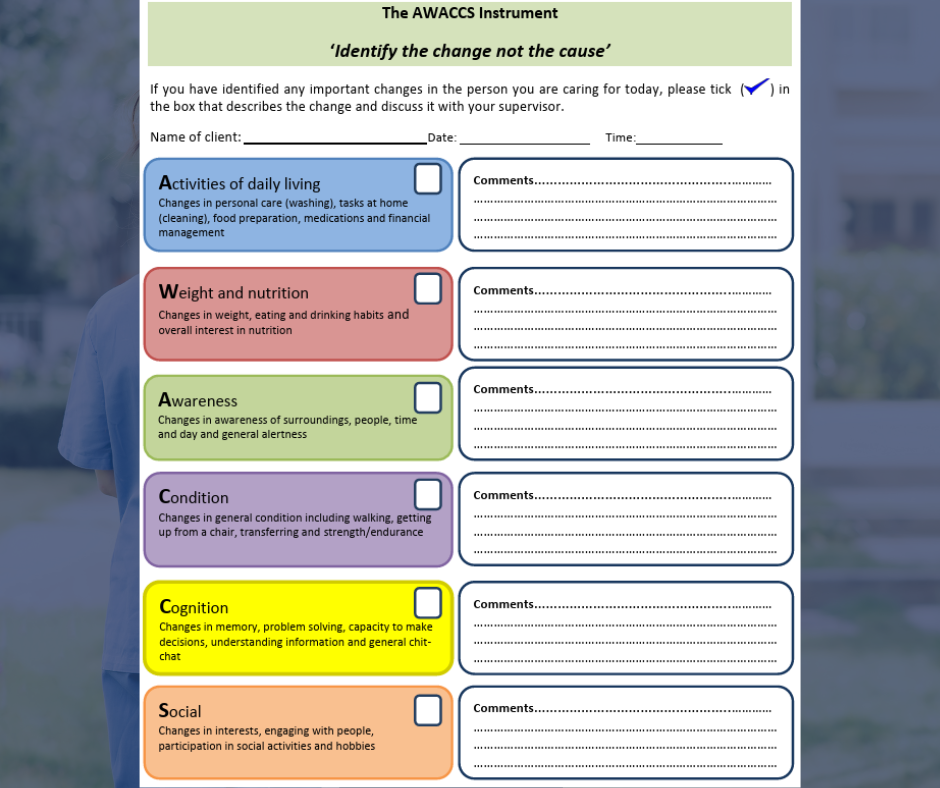
The AWACCS model is a simple documentation framework that encourages support workers to observe, assess and record changes in a client’s condition in a consistent manner. It stands for Activities of daily living, Weight and nutrition, Awareness, Condition, Cognition, and Social.
Rather than relying on memory or vague descriptions, the model provides a structed approach that helps support workers communication meaningful information with supervisors, nurses, and other healthcare professionals.
While every organization may have slightly different documentation systems, the principles behind AWACCS remain the same. Observe carefully, document accurately, and report concerns promptly.

Breaking Down the AWACCS Model
Each component of the AWACCS model encourages support workers to focus on different aspects of a client’s health and wellbeing.
Activities of Daily Living
Activities of Daily Living (ADLs) are the everyday tasks that allow a person to live independently. Changes in a client’s ability to complete these tasks are often some of the earliest indicators that additional support or medical review may be needed.
Support workers should observe and document changes in areas such as personal care including washing, dressing, and grooming. Household tasks such as cleaning and maintaining the home. Food preparation and the ability to safely prepare meals. Medication management, including remembering to take medications correctly. And financial management and the ability to manage bill or everyday purchases.
Weight and Nutrition
A client’s eating and drinking habits can provide valuable insight into their overall health and wellbeing.
Support workers should monitor for any changes in a client’s weight and nutrition such as noticeable weight loss or weight gain. Reduced appetite or interest in eating meals. Eating or drinking less than usual. Difficulties preparing or consuming food. Or Signs of dehydration or poor nutrition.
Documenting these changes over time can help identify health concerns before they become more serious.
Awareness
Awareness refers to how alert and orientated a client is within their environment.
Support workers should observe whether a client experiences changes in awareness of their surroundings, their recognition of familiar people, orientation to the time, day, or date, and their general alertness and responsiveness.
A client becoming increasingly confused or disorientated may require further assessment, as these changes can sometimes indicate a cognitive decline.
Condition
A client’s condition can gradually change over time, making regular observations essential.
Support workers should document changes relating to walking and mobility, transfers between sitting, standing or moving locations, their overall strength and endurance, and whether there is any increased fatigue or reduced physical ability.
Even small changes in strength and mobility can increase the risk of falls and impact on a client’s independence, making early documentation especially important.
Cognition
Changes in cognition can affect a client’s ability to safely manage daily activities and make informed decisions.
Support workers should observe changes in memory and recall, problem solving abilities, decision making capacity, understanding information or instructions, and everyday conversations and general chit-chat.
Subtle cognitive changes are often easier to recognise when observations are documented consistently over time, allowing patters to emerge that may warrant further assessment.
Social
A person’s social wellbeing is closely linked to their overall quality of life and can often reflect changes in their physical or mental health.
Support workers should document changes in a client’s hobbies and favourite activities, engagement with family, friends and support workers, participation in social outings or community activities, motivation to interact with others, and general enthusiasm for activities they previously enjoyed.
A client becoming withdrawn, losing interest in social activities or isolating themselves may be experiencing changes that should be reported and monitored as part of their overall care.

Why the AWACCS Model of Documentation Matters
Clients receiving support at home often experience gradual changes in their physical health, mental wellbeing and daily functioning. These changes may be subtle at first, but when they are recognised and documented consistently, they provide valuable information that allows healthcare professionals to intervene before a condition worsens.
The changes don’t always have to be negative or ones of deterioration, sometimes they can be positive changes. For example, a client with limited mobility, through the assistance of regular physiotherapy, strength and training, is now moving more freely and using less mobility aids than previously. This is important information to document so that the allied health team knows whether support is working, or whether a different approach is necessary.
Without accurate documentation, small warning signs, or positive changes can easily be overlooked. A client who becomes slightly more forgetful, less mobile, or begins eating less each day may not seem significantly different during a single visit. However, when observations are recorded consistently over time, clear patterns begin to emerge.
The AWACCS model of documentation helps support workers record these observations in a structed, objective and professional way, creating an accurate picture of a client’s overall wellbeing.

How Accurate Documentation Identifies Health Changes Earlier
The greatest strength of the AWACCS model of documentation is its consistency.
One observation on its own may not indicate a serious problem. However, when multiple support workers consistently document small changes over several days or weeks, patterns become much easier to identify.
For example, a client who gradually eats less each visit, walks more slowly, appears more tired, becomes increasingly forgetful and frequently mentions they are feeling unwell may be experiencing the early stages of an infection or another medical condition.
Because each observation has been documented objectively, healthcare professionals can review the information and make informed decisions.
Early intervention often results in better health outcomes and may prevent hospital admission or further deterioration.

Objective Documentation Makes a Difference
One of the key principles taught through the AWACCS model is documenting facts rather than opinions.
Instead of writing “The client looked unwell today”. A more objective entry would be something like. “The client required assistance to stand from her chair, she appeared pale, ate approximately half of her usual lunch and stated that she felt dizzy when walking”.
Objective documentation creates clearer communication between support workers and healthcare professionals while reducing misunderstandings.
It also supports continuity of care when multiple staff are involved.
Supporting Better Outcomes Through Communication
Documentation is only one part of the process. Equally as important is reporting concerns through the correct workplace procedures.
When support workers recognise changes early, accurately document their observations and communicate these concerns promptly, care teams are better equipped to respond appropriately.
This collaborative approach helps improve client safety, supports informed decision making and ensures the client receives the right care, at the right time.

AWACCS Model with Skills Centre Australia
Building confidence in documentation is an essential skill for every support worker.
At Skills Centre Australia, our Introduction to Support Work course teaches participants how to apply the AWACCS model of documentation to real-world care settings. Through practical learning and industry-focused training, you’ll develop the skills to recognise early changes in a client’s condition, document observations professionally and communicate effectively with the broader care team.
By learning the AWACCS model of documentation through Skills Centre Australia, you’ll be better prepared to provide safe, person-centred support while helping identify potential changes, all which contribute to looking after the client.
Whether you’re new to the care industry or looking to strengthen your documentation skills, Skills Centre Australia is here to help you build confidence, improve client outcomes and make a meaningful difference every day.