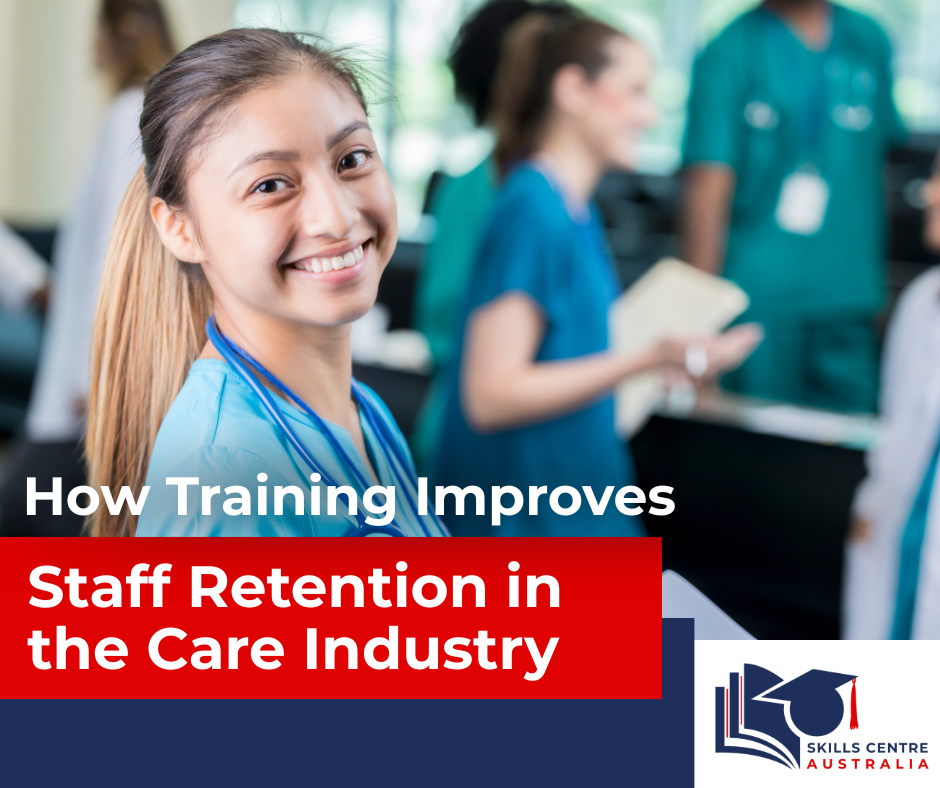
Staff retention is one of the biggest challenges facing the care sector today.
Across aged care, disability support, health and community services, organisations are experiencing high turnover, workforce shortages and increasing pressure to deliver quality care with limited resources. While pay and workload are often discussed as key issues, one of the most powerful – and sometimes overlooked – strategies for improving staff retention is training and upskilling. Investing in workforce development not only builds skills, but also increases job satisfaction, confidence, engagement and long-term commitment.
Keep reading to find out how partnering with Skills Centre Australia for staff training and upskilling can not only strengthen staff retention but also build team confidence and competence and improve client outcomes.

The link between training and staff retention
Research consistently shows that employees are more likely to stay with organisations that invest in their professional growth. In the care industry, this link is even stronger. Support workers, carers and frontline staff face complex situations every day, from managing behaviours of concern to providing personal care, supporting mental health, and responding to clinical risks.
Without ongoing training, workers can quickly feel overwhelmed, underprepared and burnt out. Over time, this leads to disengagement, reduced confidence and ultimately, resignation.
On the other hand, when staff receive regular, relevant training, they feel:
- More confident and competent in their role
- Better equipped to manage challenging situations
- Valued and supported by their employer
- More motivated to build a long-term career
This directly impacts retention, morale and overall service quality.
Building confidence and competence
One of the main reasons staff leave the care sector is feeling unprepared or unsupported. Training plays a critical role in closing this gap.
Practical, industry-relevant training helps workers develop clinical awareness, improve communication and documentation, build skills in mental health and behaviour support, understand risk management and their duty of care, and stay compliant with evolving standards and regulations
When staff feel confident in their abilities, they are more likely to enjoy their work and less likely to experience anxiety or stress. Confidence leads to better performance, stronger client relationships and increased job satisfaction.

Creating clear career pathways
Another major driver of staff turnover is the lack of career progression. Many care workers leave because they feel stuck in the same role with no clear pathway forward.
Upskilling opens the door to new opportunities, such as:
- Team leader or senior support roles
- Specialisation in mental health, dementia or complex care
- Trainer and assessor pathways
- Management or coordination positions
By offering ongoing training, organisations can show employees that there is a future within the business. This sense of growth and progression is a powerful motivator for staying long-term.
Increasing engagement and motivation
Training doesn’t just improve skills; it also improves engagement. Employees who are learning feel more connected to their work and more invested in their organisation.
When staff are given opportunities to develop, they are more likely to take pride in their role and deliver higher-quality care. They are also more likely to contribute ideas and feedback and to demonstrate loyalty to their employer.
Engaged employees are not only more productive but also significantly more likely to stay.

Reducing burnout and turnover
Burnout is a serious issue in the care industry. Heavy workloads, emotional demands, and high levels of responsibility can take a toll on workers’ mental and physical health.
Training helps reduce burnout by:
- Improving time management and efficiency
- Teaching strategies for managing stress and emotional labour
- Increasing competence in challenging situations
- Providing a sense of control and mastery
When workers feel capable and supported, they are less likely to become overwhelmed or disengaged.
Supporting compliance and quality of care
From a business perspective, training also protects organisations. Well-trained staff are more likely to follow best practice, comply with industry standards and deliver safe, high-quality care.
This leads to fewer incidents and complaints, better client outcomes, stronger organisational reputation, and lower recruitment and onboarding costs.
Retaining experienced staff also means preserving organisational knowledge, client relationships and team stability.
Why practical training makes the biggest difference
Not all training is created equal. For training to truly impact retention, it must be practical, relevant and aligned with real workplace needs.
Workers benefit most from training that:
- Uses real-life scenarios
- Is delivered by industry experts
- Applies directly to their daily role
- Builds confidence, not just theory
Practical training, as included in many of our courses at Skills Centre Australia, allows staff to immediately apply what they’ve learned, reinforcing skills and improving performance from day one.

How Skills Centre Australia supports workforce retention
Skills Centre Australia specialises in delivering practical, high-quality training designed specifically for the care sector. Our courses are built around real-world challenges and focus on developing confident, capable and compliant workers.
Partnering with Skills Centre Australia as your training provider, we can help your organisation upskill existing staff, support new workers in the industry, build specialist capability in high-needs care, improve team confidence and competence, and strengthen staff retention and engagement.
By investing in ongoing professional development, providers can create a culture of learning, growth and support – one where staff feel valued and empowered to stay.
Training as a long-term staff retention strategy
In today’s competitive care environment, retaining skilled workers is more important than ever. Recruitment alone is not enough. Organisations must focus on developing and supporting the workforce they already have.
Training and upskilling are not just a compliance requirement; it’s a strategic investment in people. It builds stronger teams, better outcomes for clients, and more sustainable organisations.
Ultimately, when staff feel confident, capable and supported in their roles, they don’t just stay, they thrive. And thriving staff are the foundation of high-quality care.
If you are interested in training with Skills Centre Australia, get in touch with our friendly team today by calling (08) 8340 6875, emailing us at info@kcskillscentre.com.au, or visiting our website, www.kcskillscentre.com.au.